
Student Engagement Is More Than Participation
Student engagement may be one of the most overused and underexamined phrases in education. Schools talk about it constantly. Products promise to increase it. Teachers are asked to improve it. Districts invest in programs, platforms, and initiatives designed to produce more of it.
But too often, engagement is defined by what is easiest to see: students are busy, attentive, compliant, talking, collaborating, or completing work.
Those things can matter, but they are not enough.
A classroom can look active without requiring much thinking. A lesson can include discussion without building understanding. A digital activity can feel interactive while still asking students to do very little intellectual work.
EdTech has reinforced this definition through logins, time on task, clicks, and completion rates.
These metrics can be useful signals of activity, but they cannot tell us, on their own, whether students are thinking deeply, making meaning, using evidence, or building understanding. .
The engagement that matters is that students are intellectually present in the work.
This distinction is especially important in social studies. Students can look engaged while copying vocabulary, clicking through a task, or listening quietly. A class can sound engaged because students are talking. But none of those behaviors guarantees that students are making sense of power, conflict, geography, citizenship, culture, economics, or change.
Instead of asking, Are students engaged?, we should be asking a better question:
“What kind of thinking does this lesson require students to do?”
An Engaged Classroom May Not Always Look Neat
Consider two eighth-grade classrooms during a unit on the American Revolution.
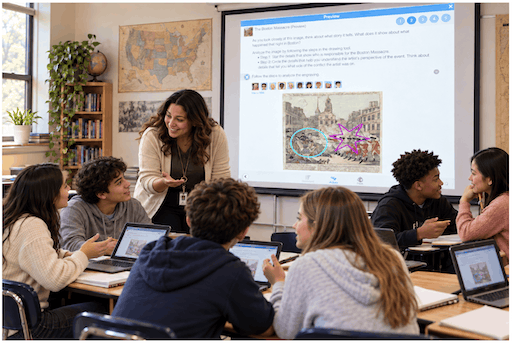
In one classroom, every student appears busy. Worksheets are filled in. A few hands go up when the teacher asks a question. Students are quiet, compliant, and mostly “on task”.
From the hallway, this looks like engagement.
In another classroom, the room is less organized, less focused. Four students are debating whether Paul Revere’s engraving of the Boston Massacre should be trusted as historical evidence. Two students are rereading excerpts from trial testimony to check a detail. Another student has not spoken in several minutes but is writing a claim about why propaganda can be powerful even when it leaves out important context.
The teacher, moving between groups, pressing students to explain what evidence supports their thinking.
The second classroom may look less tidy, but it is a much clearer view of intellectual engagement.
Students are not simply learning that the Boston Massacre happened. They are thinking about evidence, perspective, purpose, and interpretation. They are considering whether an image can be powerful and misleading at the same time. They are beginning to understand that history is not only a record of events but also a discipline that asks how we know what we think we know.
That kind of engagement is harder to capture on a checklist. But it is much closer to the kind of thinking social studies is supposed to develop.
Engagement Is Bigger Than Discussion
One reason engagement is misunderstood is that it is often equated with student talk..
Social learning matters. Students need opportunities to speak, listen, respond, disagree respectfully, and build understanding with others. But discussion is not automatically engagement.
Students can talk without listening closely. They can participate without changing or deepening their thinking. At the same time, a quiet student may be highly engaged while rereading a source, or preparing a written response.
The goal is not more noise. The goal is more thinking.
High-quality engagement gives students multiple ways into the work: reading, writing, discussing, questioning, analyzing, listening, revising, and applying. It recognizes that learning is both intellectual and social. Students need time to think for themselves, but they also need opportunities to test those ideas with others.
The classroom should give them opportunities not just to receive ideas, but to build, challenge, and refine them together.
Knowing and Doing Are Not the Same as Thinking and Learning
A lot of school is organized around what students need to know and what students need to do.
Both matter. Students need knowledge. They need historical context, academic vocabulary, geographic concepts, civic structures, economic principles and enough background knowledge to make sense of new information.
They also need to do things with that knowledge. They need to read sources, interpret maps, analyze visuals, compare perspectives, write responses, and participate in discussions.
But knowing and doing are not the final goals of learning. They are the building blocks students use to think and learn.
That distinction is especially important in social studies, where content can easily become a long list of names and dates and tasks to complete.. Students learn people, dates, amendments, regions, events, and systems. They answer questions, complete notes, fill in charts, and take assessments.
All of that can be useful, but they become more powerful when students understand what the knowledge is helping them make sense of.
Relevance matters here too. That does not mean every lesson has to be about students’ personal lives or current events. It means the learning needs a reason.
Students need to see that the facts and tasks are helping them understand something worth understanding. Intellectual engagement gives knowing and doing that purpose.
Facts become evidence. Vocabulary becomes a tool for explanation. Reading becomes investigation. Writing becomes meaning-making. Discussion becomes a way to test and refine ideas. That is the shift social studies needs. Not less content. Not less skill practice. More purposeful content and more meaningful skill practice in service of thinking and learning.
Social Studies Is Built for Intellectual Engagement
Social studies has a powerful advantage when it comes to engagement because the discipline is full of questions that matter.
Why did people make this decision? Who benefited? Who was left out? What changed? What stayed the same? What evidence should we trust? How did geography shape human choices? How should power be limited? Why do people disagree about the same event?
These questions are not decorations added to the lesson after the content is covered. They are the reason the content matters.
A lesson on the American Revolution is not only about knowing names, dates, acts, and battles. Those institutions help students understand how authority is structured, limited, challenged, and used.
Social studies becomes engaging when students have a reason to use what they know and do. They need something to investigate, explain, compare, question, or apply.
That does not mean every lesson needs to become a debate or a project. Intellectual engagement can happen through a careful reading, a strong question, a map analysis, a written explanation, a structured discussion, a comparison of sources, or a short response.
The key is that students are not simply receiving information or completing activities. They are using content to build understanding.
Student Voice Means Making Thinking Visible
If intellectual engagement matters, then student voice matters too. But student voice should not be reduced to students talking more.
In a traditional classroom exchange, a teacher asks a question, a few students raise their hands, one student answers, and the class moves on. That may keep the lesson moving, but it gives the teacher very little information about what most students are thinking.
What we want in social studies is closer to volleyball. An idea is served into the room, and students help keep it in the air. They receive it, pass it, set it up, build on it, and send it back with more force or precision. The best classroom conversations, like the best rallies, last long enough for multiple people to shape where the idea goes next.
Strong student-centered instruction creates multiple ways into the learning. Some students contribute through discussion. Others may first contribute through writing, source annotation, small-group work, polls, organizers, class walls, or evidence-based responses. The goal is not simply to hear from more students; it is to make more students’ thinking visible.
When that happens, teachers gain access to ideas, misconceptions, questions, and partial understandings that might otherwise remain hidden. Students benefit too. They can see how others are thinking, compare ideas, reconsider their own understanding, and contribute to a shared line of inquiry. In a subject built around perspective, evidence, interpretation, and dialogue, creating those opportunities is an important part of meaningful engagement.
High-Quality Engagement Is Teacher-Guided
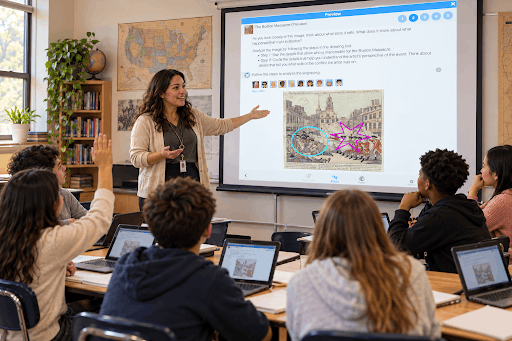
Conversations about engagement sometimes make it sound like the goal is to get students active so the teacher can step back. But high-quality engagement is teacher-guided. Students need meaningful questions, strong materials, clear expectations, and opportunities to think. They also need teachers who can guide discussion, clarify confusion, connect ideas, and decide when to move forward or slow down.
A source does not teach itself, a discussion does not become rigorous simply because students are talking, and a digital activity does not become engaging because students are clicking. The teacher turns activity into learning. The teacher decides which student response should be highlighted, which misconception needs attention, which question should be asked next, which idea needs evidence, and which connection should be made explicit.
This is why districts need to think carefully about the materials and tools they provide. It is easy to tell teachers to make instruction more engaging. It is much harder for teachers to design meaningful questions, find strong sources, build appropriate scaffolds, create opportunities for every student to participate, facilitate discussion, assess understanding, and adjust instruction—all while covering the required content. If districts want more intellectual engagement, they need to provide teachers with resources that make that kind of instruction achievable every day.
Making High-Quality Engagement Achievable at Scale
This is the instructional challenge Exploros was designed to address. Exploros defines engagement as active, visible participation by all students in meaningful learning.
That means engagement is not measured only by whether students logged in, clicked through, spent time on task, or submitted a response. Those things tell us something about activity, but the . more important question is what student activity reveals about understanding.
Can teachers see the claims students are making, the evidence they are using, the misconceptions they may be developing, and the ideas worth bringing into discussion?Exploros is designed to make more of that thinking visible while giving teachers practical ways to act on it during instruction.
The approach is built around three connected principals: teacher-guided, student-centered, and device-enabled.
- Teacher-guided means the teacher remains central to instruction. Exploros gives teachers ready-to-teach experiences, instructional support, discussion questions, pacing structures, and real-time access to student responses. This helps teachers see where students are making sense, where they are confused, and when a student response can be used to drive discussion, clarification, or extension.
- Student-centered means students are active participants in the lesson rather than simply recipients of information. They are thinking, responding, investigating, discussing, analyzing, and explaining. Polls, walls, organizers, written responses, source work, and collaborative tasks give ALL students frequent opportunities to enter the learning and show what they are thinking.
- Device-enabled means technology serves instruction rather than becoming the instruction. The device helps broaden participation, collect student thinking, and give teachers information they can use while the learning is still happening.
The screen is not the destination; it is a pathway back to teacher-guided discussion, clarification, evidence use, and deeper understanding.
Together, these principles address a fundamental instructional challenge: teachers cannot respond to thinking they cannot see. Exploros helps make that thinking visible while providing practical ways for teachers to use it to move instruction forward.
It also makes this kind of teaching more achievable. Teachers do not have to build every inquiry, source set, prompt, organizer, and discussion pathway from scratch. Instead, they have a structured instructional experience that gives students something meaningful to think about and gives teachers the tools to guide that thinking.
The result is not technology for technology’s sake, but a classroom model where all students participate, teachers have greater visibility into learning, and social studies content becomes more meaningful.
What District Leaders Should Look For
If districts want stronger engagement, they need to look beyond surface indicators. The question is not only whether students are busy, whether the lesson is digital, or whether the classroom appears active.
A better question is: What are students doing with what they are learning?
That question can help district leaders look for stronger evidence of engagement:
- Are students using evidence to develop and support ideas?
- Are they connecting facts to larger concepts and questions?
- Do all students have meaningful ways to make their thinking visible?
- Can the teachers see student understanding and misconceptions while learning is happening?
- Does the curriculum support reading, writing, discussion, analysis, and application?
- Does it make this kind of instruction achievable for newer teachers as well as experienced teachers?
District leaders should ask similar questions when evaluating curriculum, supplemental resources, and instructional technology. Those questions move district decisions toward the instructional core. They help districts avoid mistaking tidiness for engagement or activity for rigor.
Engagement Is Not the Finish Line
Student engagement matters because learning requires students to be present in the work, but engagement is not the finish line. The goal is not just to get students thinking more deeply.
In social studies, that means helping students build knowledge, use evidence, communicate clearly, listen to others, understand context, recognize complexity, and make sense of the world. It means connecting facts to concepts, tasks to purpose, and classroom learning to larger questions about people, places, systems, and civic life.
That kind of engagement does not happen simply because a lesson is digital, students are talking, or everyone appears busy. It happens when teachers have strong instructional materials, meaningful questions, visibility into student thinking, and a learning design that uses knowing and doing as the building blocks for thinking and learning.
The engagement that matters most is the kind that helps students think more deeply, make meaning, and build understanding that lasts.
About the Author: Chris Olsen, is the Director of Curriculum for Exploros who is dedicated to transforming learning environments by empowering educators, administrators, and organizations with inquiry-based and culturally responsive strategies. Chris has years of experience in curriculum development, instructional leadership, and professional development, and specializes in inquiry-based learning that transforms schools.