Add a Curriculum Bundle to Your Account!
Please select a bundle.



The Pack contains associated resources for the learning experience, typically in the form of articles and videos. There is a teacher Pack (with only teacher information) and a student Pack (which contains only student information). As a teacher, you can toggle between both to see everything.
Here are the teacher pack items for Women of the Revolution:

Overview In this experience, students name a woman who was active during the American Revolution. Then they explore the actions of the Daughters of Liberty. Next, they explain Abigail Adams’s “Remember the Ladies” letter. Finally, they analyze the Betsy Ross story and explain why historians consider it a legend. In scene 4, students explain how historians use primary sources to verify the facts of historical events. If your students have not yet been introduced to the terms primary sources and secondary sources, introduce them before starting this experience. Encourage interested students to research additional women and the role of women in the war effort. Estimated duration: 30–40 minutes Discovery Reading A printable Discovery Reading is included in the student pack as a support for understanding the experience’s core content and concepts. This Discovery Reading is not necessary to complete the experience and serves as an optional support resource. Vocabulary Words: These vocabulary words are used in the experience or connect closely to the standards and content students examine. Students should understand these terms as they work through the experience. Objectives
When we talk about the American Revolution and the founding of the nation, we often hear about Founders like George Washington, Thomas Jefferson, and Benjamin Franklin. However, many women also played important roles during the Revolution. In this experience, you will learn about some of these women and the different ways they contributed.
Objectives
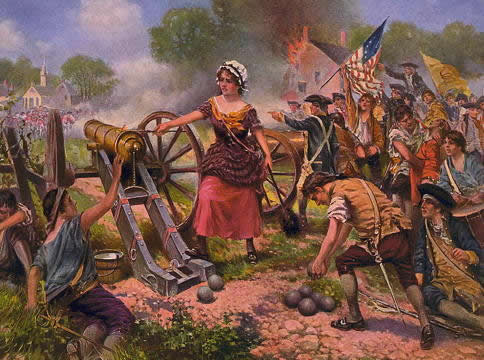
Molly Pitcher Firing Cannon at Monmouth, by E. Percy Moran (1911)
Name a woman who contributed to the American Revolution. To list more than one name, separate them with a comma, like this: Alexa, Blanca.
Sample names that students may know: Betsy Ross, Abigail Adams, Molly Pitcher, Martha Washington, Phillis Wheatley. If students have difficulty coming up with names, point out that the historical narrative often ignores the point of view of “minorities” and “the other.”
In recent years, historians have worked to tell U.S. history from the viewpoints of more of the people who experienced it. This includes women, African Americans, Native nations, immigrants, and other groups whose experiences were often left out of history books. Including these different viewpoints can give us a fuller understanding of the past.
When everyone is ready to continue, unlock the next scene.


