Add a Curriculum Bundle to Your Account!
Please select a bundle.





The Pack contains associated resources for the learning experience, typically in the form of articles and videos. There is a teacher Pack (with only teacher information) and a student Pack (which contains only student information). As a teacher, you can toggle between both to see everything.
Here are the teacher pack items for Russia and the Republics: Society and Culture:

Overview In this experience, students examine Russian culture through architecture, music, visual and folk art, literature, and ballet. They consider how these forms of cultural expression reflect beliefs, traditions, history, and artistic ideas. Students then study Rudolf Nureyev’s experience to analyze how Soviet government control could both support the arts and limit artistic freedom. Note that there is no traditional quiz at the end of this experience. Instead, students have multiple opportunities to demonstrate understanding through written responses that require them to interpret cultural evidence, make connections across examples, and explain their thinking. Use these writing tasks as the primary assessment of student understanding. Look for students to support their ideas with specific examples from the experience and to explain broader concepts such as cultural expression, the relationship between culture and society, and the ways government can influence the arts. Objectives:
Russia has a long cultural history shaped by many different influences. Religion, geography, political change, contact with neighboring peoples, and connections with other parts of Europe and Asia all influenced Russian art, music, literature, architecture, and dance.
Beginning in the 1700s, Russian rulers such as Peter the Great encouraged greater contact with western Europe. New artistic styles and more secular, or nonreligious, subjects became increasingly common. During the 1800s, Russian writers, composers, painters, and performers produced works that became influential both within Russia and around the world.
After the Russian Revolution and the creation of the Soviet Union, the government placed greater controls on artistic expression. Some artists created works that supported government goals, while others faced censorship, restrictions, or pressure to change their work. Even under these limits, Soviet artists continued to make important contributions to music, dance, film, literature, architecture, and the visual arts.
Since the end of the Soviet Union in 1991, artists in Russia and the other former Soviet republics have continued to develop new forms of cultural expression while also drawing on older traditions.
In this experience, you will examine several examples of art and cultural expression from Russia and the surrounding region and consider what they reveal about history, society, and cultural change.
Objectives:
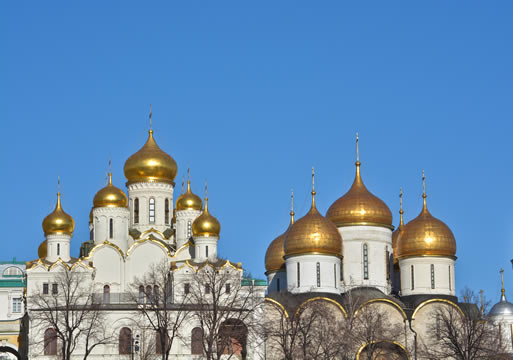
The Kremlin Church in Moscow
The church shown above includes architectural features often associated with Russian Orthodox churches. One of the most recognizable features is the use of rounded or onion-shaped domes. These domes became an important part of Russian religious architecture and can help identify the influence of Orthodox Christianity on Russian culture.
What do the shape and design of these domes suggest about the importance of religious architecture in Russian culture? Use details from the image in your response.
Invite students to share the details they noticed in the church’s design and explain how those details support their ideas about the importance of religious architecture in Russian culture. As students respond, draw attention to the size, shape, decoration, and visibility of the domes. Emphasize that religious buildings can serve as cultural markers because architecture can reflect beliefs, traditions, artistic styles, and historical influences. Possible follow-up questions include:
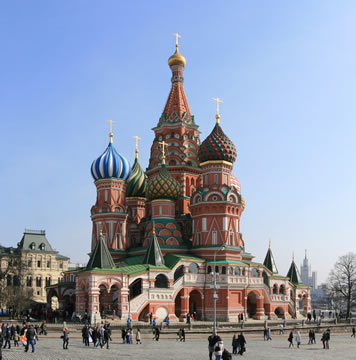
St. Basil Cathedral, Moscow
The domes and other features of Russian Orthodox churches became important cultural symbols over time. During the imperial period, especially in the 1800s, some Russian architects drew on traditional church and medieval Russian designs when creating public buildings and other important structures.
This style, often called Russian Revival architecture, used features such as decorative towers, arches, colorful patterns, and shapes associated with older Russian buildings. By using these familiar designs in new settings, architects connected public spaces to Russia’s history and cultural traditions.
When everyone is ready to continue, unlock the next scene.


