Add a Curriculum Bundle to Your Account!
Please select a bundle.


The Pack contains associated resources for the learning experience, typically in the form of articles and videos. There is a teacher Pack (with only teacher information) and a student Pack (which contains only student information). As a teacher, you can toggle between both to see everything.
Here are the teacher pack items for Native American Relations in the Republic of Texas:

Overview In this experience, students first review the names of indigenous groups that lived in Texas at the time of the Republic of Texas. Then they examine Sam Houston’s policy toward the indigenous people living in Texas. Next they analyze the effect of Mirabeau Lamar’s “Indian policy” on the Texas national debt. Finally they learn about the Texas Rangers and consider the role they played in shaping life in Texas. If you have access to leveled readers about Sam Houston and the Cherokee, Mirabeau Lamar, or the Texas Rangers, assign them to the students in parallel to this experience. Estimated duration: 35-45 minutes Discovery Reading A printable Discovery Reading is included in the student pack as a support for understanding the experience’s core content and concepts. This Discovery Reading is not necessary to complete the experience and serves as an optional support resource. Vocabulary Words: These vocabulary words are used in the experience or connect closely to the standards and content students examine. Students should understand these terms as they work through the experience. Objectives
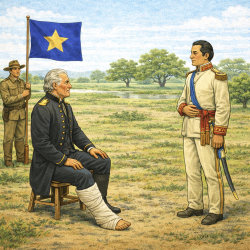
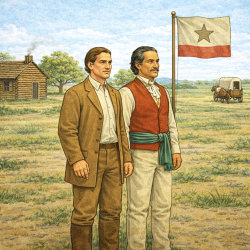
As Texas settlements grew, many Anglo-Texan settlers moved onto the homelands of Indigenous peoples. This led to conflict because Indigenous nations were trying to protect their land and communities, and many settlers wanted Indigenous people forced to leave. In this lesson, you will compare the different approaches of the first two presidents of the Republic of Texas, Sam Houston and Mirabeau B. Lamar. One approach focused more on peace and treaties, and the other relied more on removal and military force.
Objectives
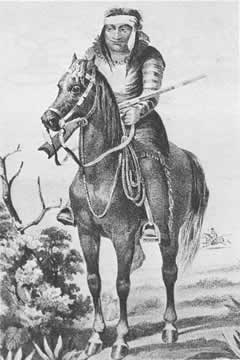
A Lipan Apache person in Texas
Name at least one group of indigenous people that lived in what is now Texas. To list more than one, separate the names with a comma, like this: British, French.
Students should be able to name at least one of the groups highlighted in Unit 1 of this course. The indigenous people who lived in the area today known as Texas include: Lipan Apache, Caddo, Jumano, Karankawa, Coahhuiltecan, Wichita, Tonkawa, and Comanche. The Jumanos lived in the disputed territory of the Texas borders. As students learned in an earlier unit, the Comanche arrived in Texas after the Europeans. It’s also important to note to students that these indigenous people still exist today, some of which still live in Texas.