Add a Curriculum Bundle to Your Account!
Please select a bundle.



The Pack contains associated resources for the learning experience, typically in the form of articles and videos. There is a teacher Pack (with only teacher information) and a student Pack (which contains only student information). As a teacher, you can toggle between both to see everything.
Here are the teacher pack items for Totalitarianism and Its Influence in History:


Overview Students distinguish between limited and unlimited government and identify the dangers that can arise when government power has few effective limits. Then they learn about totalitarianism and how totalitarian governments seek broad control over politics and society. Next, they examine examples of twentieth-century fascist and communist governments that became totalitarian. Finally, students compare the ways these governments used power and control. Estimated duration: 45-60 minutes Vocabulary Words: Objectives:
Various forms of government have existed throughout human history, each organizing power in different ways. One of these forms is totalitarianism, in which a government seeks extremely broad control over political life and society. In the twentieth century, totalitarian governments caused enormous suffering and loss of life. In this experience, you will learn what totalitarianism is, how these governments maintained control, and the human costs of that control.
Objectives:
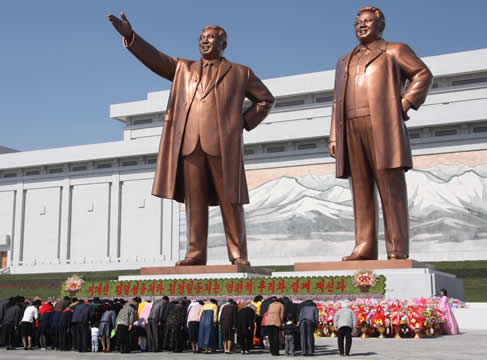
North Koreans Bow Before Statues of Their Leaders, Past and Present
Think about two different forms of government: limited government and unlimited government. Before you learn what these terms mean, look closely at the words limited and unlimited. Where have you heard those words before? What do they usually mean?
Use what you already know about those words to complete the table.
Brainstorm what you think the differences are between limited government and unlimited government. In the chart, record a definition or features. They do not have to be in complete sentences.

Discuss student responses.
When everyone is ready to continue, unlock the next scene.


