Add a Curriculum Bundle to Your Account!
Please select a bundle.



The Pack contains associated resources for the learning experience, typically in the form of articles and videos. There is a teacher Pack (with only teacher information) and a student Pack (which contains only student information). As a teacher, you can toggle between both to see everything.
Here are the teacher pack items for Northern and Central South America: Geographic Passport:


Overview In this experience, students examine the physical and human geography of Northern and Central South America. They identify countries in the region and use political, physical, population, and climate maps to investigate geographic patterns. Students then examine how climate and other physical features shape natural environments in selected countries. Finally, they research an environmental issue affecting one country and explain how the issue is connected to its geography, its effects on people and the environment, and efforts to address it. The Northern and Central South American countries in this region include: Objectives:
Northern and central South America include countries with a wide range of landscapes, from Caribbean coastlines and tropical forests to mountains, rivers, grasslands, and highland regions. These physical features influence climate, settlement, transportation, natural resources, and the ways people use the land.
In this experience, you will explore the geography of countries in northern and central South America and examine the physical and human features that make the region distinct.
Objectives:
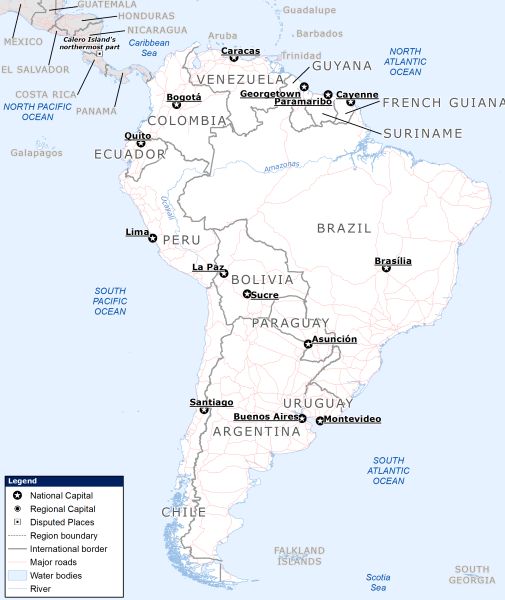
Political Map of South America
South America includes a wide variety of physical environments, including mountains, grasslands, tropical forests, deserts, rivers, and long coastlines.
Watch South America | Destination World to get an overview of the continent’s geography. As you watch, pay attention to the different landscapes and physical features you notice.
What is one geographic pattern you notice on the map of Northern and Central South America? Use evidence from the map to explain your answer.
When everyone is ready to continue, unlock the next scene.


