Add a Curriculum Bundle to Your Account!
Please select a bundle.





The Pack contains associated resources for the learning experience, typically in the form of articles and videos. There is a teacher Pack (with only teacher information) and a student Pack (which contains only student information). As a teacher, you can toggle between both to see everything.
Here are the teacher pack items for Southern and Eastern Africa: Geographic Passport:

Overview In this experience, students examine the physical geography of Southern and Eastern Africa and analyze how landforms, water, vegetation, and natural resources influence human activity. They investigate how environmental changes affect the choices people make and how human activities can modify physical environments. Finally, students examine tourism at Ngorongoro from multiple perspectives to evaluate how economic opportunities, conservation, and community needs can be balanced. Objectives:
Geography affects human life in many ways. Landforms, climate, water, vegetation, and natural resources can influence where people settle, what kinds of work are possible, and how communities travel or obtain food and water.
But the relationship works in both directions. People also change environments by building cities and roads, farming land, using water, mining resources, and developing places for tourism.
Eastern and Southern Africa include large cities, mountains, plateaus, river systems, lakes, grasslands, forests, deserts, and coastlines. Understanding the region requires looking at both its physical geography and the ways people interact with those environments.
In this experience, you will examine the physical geography of Eastern and Southern Africa and investigate how people adapt to, depend on, and modify the environments around them.
Objectives:
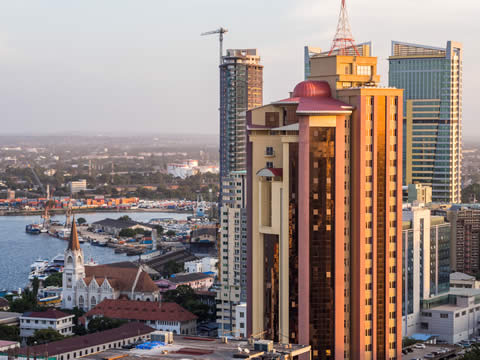
What evidence in this photograph shows ways people have modified the physical environment?
After students respond, invite several students to identify the evidence they used. Use the discussion to distinguish physical features from human-made features. Students may identify buildings, roads, the waterfront, transportation systems, or other evidence of urban development. Explain that cities provide one clear example of people modifying environments, but human-environment interaction also occurs in rural areas through farming, grazing, mining, water use, and tourism. Possible follow-up questions include:
When everyone is ready to continue, unlock the next scene.


