Add a Curriculum Bundle to Your Account!
Please select a bundle.





The Pack contains associated resources for the learning experience, typically in the form of articles and videos. There is a teacher Pack (with only teacher information) and a student Pack (which contains only student information). As a teacher, you can toggle between both to see everything.
Here are the teacher pack items for West and Central Africa: Society and Culture:

Overview In this experience, students examine how traditions, celebrations, ceremonies, and other cultural practices reflect the beliefs, values, identities, and histories of communities in West and Central Africa. They investigate cultural examples from several countries, compare the purposes different traditions serve, and analyze how traditions can preserve cultural knowledge while also changing over time. Finally, students use evidence from across the experience to explain why celebrations, ceremonies, and traditions can be important markers of culture. In Scene 2, students will work together in small groups, each group assigned one of eight different countries. Objective:
West and Central Africa includes more than twenty nations in a vast region. If you assume that the cultures and societies within that region are quite varied, you are correct! You will explore some of this variety in this experience.
Objective:
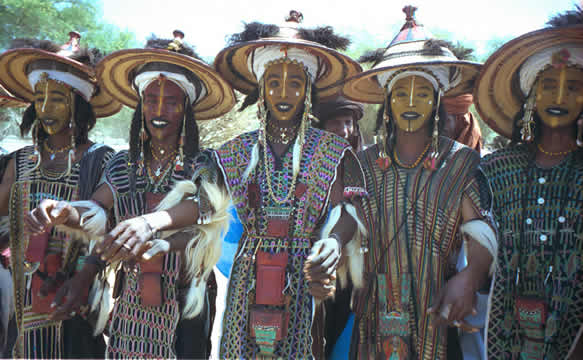
Wodaabe Dance in Niger
Culture includes many parts of life, including language, religion, food, music, art, family relationships, beliefs, and traditions. Some parts of culture become especially visible during celebrations and ceremonies.
A ceremony can do more than mark a special occasion. It may bring people together, express shared beliefs or values, connect people with earlier generations, or mark an important stage of life. Examining what people do during a ceremony and why they do it can therefore provide evidence about a culture.
One example comes from the Wodaabe, a group whose communities live across parts of West and Central Africa. Some Wodaabe communities participate in the Gerewol, a gathering that includes dancing, music, dress, social interaction, and courtship traditions.
In this experience, you will examine traditions, celebrations, ceremonies, and other cultural practices to understand what they can reveal about the societies of West and Central Africa.
Examine The Men Competing for Love in the Deserts of Chad. As you examine the photographs and text, look beyond what participants are wearing or doing. Think about what the Gerewol may reveal about the community and the purposes the ceremony serves.
What does the Gerewol reveal about Wodaabe culture? Identify one detail from the source and explain what it suggests about the ceremony’s importance to the community.
After students respond, invite several students to identify the evidence they used and explain the inference they made from it. Use the discussion to reinforce that cultural practices should be understood within the societies where they occur. Encourage students to move beyond describing clothing, appearance, or dancing and consider larger ideas such as community, courtship, identity, artistic expression, and the continuation of traditions. Possible follow-up questions include:
Divide students into their small groups for the next scene. Assign each group one of the following countries: Burkina Faso, Cameroon, Chad, Democratic Republic of Congo, Ivory Coast, Mali, Niger, or Senegal.
When everyone is ready to continue, unlock the next scene.


