Add a Curriculum Bundle to Your Account!
Please select a bundle.


The Pack contains associated resources for the learning experience, typically in the form of articles and videos. There is a teacher Pack (with only teacher information) and a student Pack (which contains only student information). As a teacher, you can toggle between both to see everything.
Here are the teacher pack items for West and Central Africa: History and Its Influence, Part 1:

Overview In this experience, students examine the growth of powerful kingdoms and trade networks in West and Central Africa and the connections these societies developed with other regions. They then trace how the Atlantic slave trade transformed existing economic and political relationships. Finally, students investigate European colonial expansion and explain how the shift toward direct foreign control affected African societies. Objectives:
Long before European countries established colonies in Africa, West and Central Africa were home to powerful kingdoms, cities, trade networks, and centers of learning. These societies developed systems of government, produced valuable goods, and built connections with other parts of Africa and beyond.
Trade helped some kingdoms grow wealthy and influential. Gold, salt, textiles, and other goods moved across long-distance routes, while people, religions, technologies, and ideas moved with them. These connections helped shape important states such as the Mali Empire.
One of Mali’s most famous rulers was Mansa Musa, who ruled during the 1300s. He became known far beyond West Africa for his wealth and for the connections his empire had with other regions. The image below comes from a European map created during that century and shows how Mansa Musa was represented by people outside Mali.
As you examine the image, think about what details suggest about Mansa Musa’s power, wealth, and importance.
In this experience, you will examine how kingdoms and trade shaped West and Central Africa, then trace how the Atlantic slave trade and European colonial expansion changed relationships within the region and with other parts of the world.
Objectives:
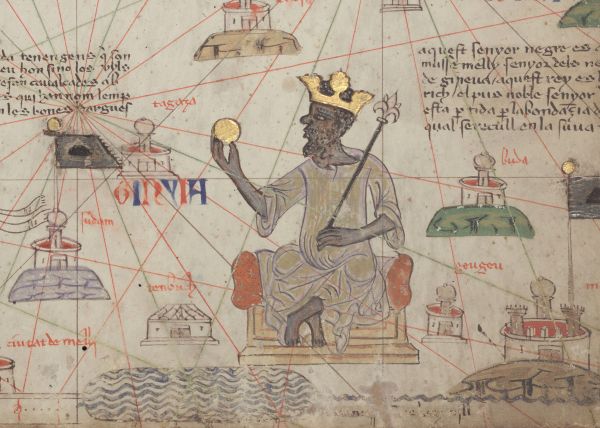
What detail in the image stands out to you most? Respond with a one or two word phrase. To list more than one, separate them with a comma like this: Rome, Paris.
After students respond, review the patterns that appear in the word cloud. Ask several students to point to the specific visual evidence that led to their response. Use the discussion to distinguish observation from interpretation. Students may notice the crown, throne, gold object, staff, or the way Mansa Musa is positioned prominently on the map. They may infer wealth, political power, or importance, but ask them to explain which details support those ideas. Then introduce the larger question students will investigate: Why would a West African ruler be shown so prominently on a map created far from Mali? Possible follow-up questions include:
When everyone is ready to continue, unlock the next scene.


