Add a Curriculum Bundle to Your Account!
Please select a bundle.





The Pack contains associated resources for the learning experience, typically in the form of articles and videos. There is a teacher Pack (with only teacher information) and a student Pack (which contains only student information). As a teacher, you can toggle between both to see everything.
Here are the teacher pack items for West and Central Africa: Government and Economy:

In this experience, students examine how natural resources influence governments and economies in West and Central Africa. They begin with a Ghanaian business that turns bamboo into an economic opportunity, then compare the governments, resources, industries, and trade of several countries in the region. Next, students investigate the diamond trade to analyze how control of valuable resources can create both economic opportunities and serious challenges. Finally, students use evidence from across the experience to explain why natural resources alone do not determine a country’s economic or political outcomes. Objectives:Overview

Every economy depends on resources. These may include natural resources such as forests, minerals, fertile soil, and water, as well as human resources such as workers, knowledge, and skills. Having a resource, however, does not automatically determine how an economy will develop.
People and businesses make decisions about how resources can be used. Governments also make decisions that can influence who has access to resources, how they are traded, and how the benefits from them are distributed.
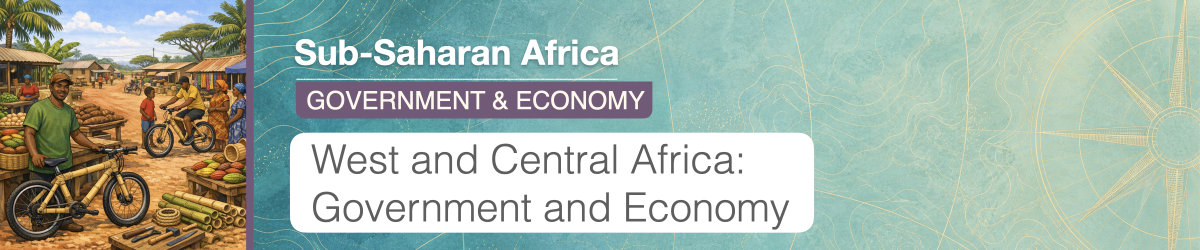
Ghana provides one example. Bamboo grows in parts of the country and can be used as a raw material. One Ghanaian company found a way to turn that resource into a manufactured product.
Watch Grow Your Own Bike. As you watch, pay attention to how the company turns a resource found in Ghana into an economic opportunity.
In this experience, you will investigate how natural resources can influence economies and governments in West and Central Africa and why the same kind of resource can create different opportunities and challenges in different places.
Objectives:
How does the bamboo-bike company turn a natural resource into an economic opportunity? Record evidence from the video.

After students respond, invite several students to explain the steps they identified between the bamboo resource and the finished bicycles. Use the discussion to emphasize that a natural resource has economic value partly because of what people do with it. Workers, skills, technology, businesses, transportation, investment, and markets can all help transform a raw material into a product that creates jobs or income. Possible follow-up questions include:
When everyone is ready to continue, unlock the next scene.


