Add a Curriculum Bundle to Your Account!
Please select a bundle.




The Pack contains associated resources for the learning experience, typically in the form of articles and videos. There is a teacher Pack (with only teacher information) and a student Pack (which contains only student information). As a teacher, you can toggle between both to see everything.
Here are the teacher pack items for The Battle of the Alamo:

Overview In this experience, students learn key facts about the Battle of the Alamo. Then they research some of the famous defenders, and examine both historical and legendary stories about them. Finally, they analyze Travis’s letter “To the People of Texas and All Americans in the World.” Students will collaborate in small groups for scene 2 to scene 4. Objectives:
By early 1836, the Texas Revolution had already been underway for several months. Texan forces had won early victories at Gonzales, Goliad, and San Antonio, and Mexican troops had temporarily withdrawn from San Antonio de Béxar.
President Antonio López de Santa Anna then led a large Mexican army north into Texas to regain control of the region and defeat the rebellion. In San Antonio, a smaller Texan force occupied the former Spanish mission known as the Alamo and prepared for the arrival of the Mexican army.
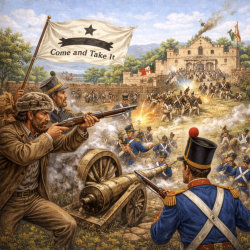
The Battle of the Alamo lasted from February 23 through March 6, 1836. In this lesson, you will examine why the battle happened, who took part in it, what occurred during the fighting, and why the Alamo became an important event in the Texas Revolution.
Objectives:
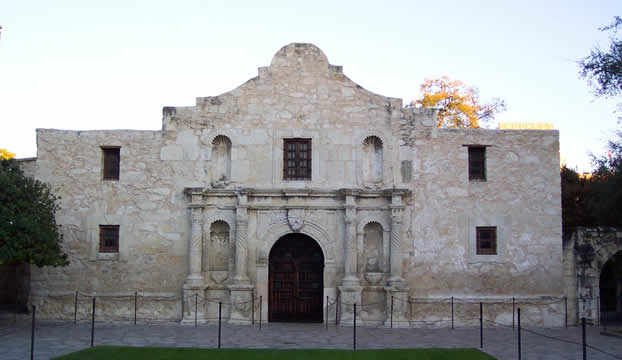
The Alamo as it appears today
What one word describes why people might choose to defend a place even when defeat seems likely? To list more than one word separate them with a comma like this: dog, cat.
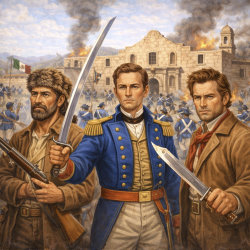
Use the word cloud to discuss the different motivations students think might lead someone to stay and fight at the Alamo. Ask students to explain why they chose words such as duty, loyalty, courage, resistance, sacrifice, or freedom. Emphasize that people who fought at the Alamo may not all have had the same reasons for being there. Then activate prior knowledge by asking: Students may recognize names such as Davy Crockett, Jim Bowie, and William B. Travis. Explain that the lesson will help them separate what they already know, or think they know, from what the historical evidence shows about the battle and the people involved.
Divide students into their small groups for the next two scenes. When everyone is ready to continue, unlock the next scene.