Add a Curriculum Bundle to Your Account!
Please select a bundle.




The Pack contains associated resources for the learning experience, typically in the form of articles and videos. There is a teacher Pack (with only teacher information) and a student Pack (which contains only student information). As a teacher, you can toggle between both to see everything.
Here are the teacher pack items for Two Revolutions: Texan and American:

Overview In this experience, students review basic information about the Texas and American Revolutions and compare and contrast the two. Next, they explore the life and contributions of Tejano officer Juan Seguín. Finally, they write a letter from Seguín’s point of view that explains his reasons for supporting the Texas Revolution and connects his experience to similarities and differences between the Texas and American Revolutions. There is no traditional quiz at the end of this experience. Instead, students demonstrate their understanding through the final creative writing task. Their letter should draw on what they learned about both the American and Texas Revolutions, as well as Juan Seguín’s experiences, to make historically accurate connections between the two revolutions. The task serves as the culminating opportunity for students to apply and synthesize the lesson content. Objectives:
In this lesson, you will compare the Texas Revolution with the American Revolution. Although the two revolutions happened at different times and in different places, both involved people challenging an existing government and fighting over questions of political power and independence.
You will first review key information about the American Revolution and the Texas Revolution. Then you will identify important similarities and differences in their causes, goals, leaders, events, and outcomes.
Objectives:
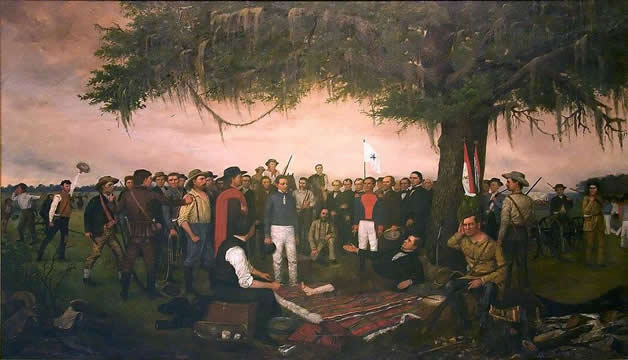
The Surrender of Santa Anna, by William Henry Huddle
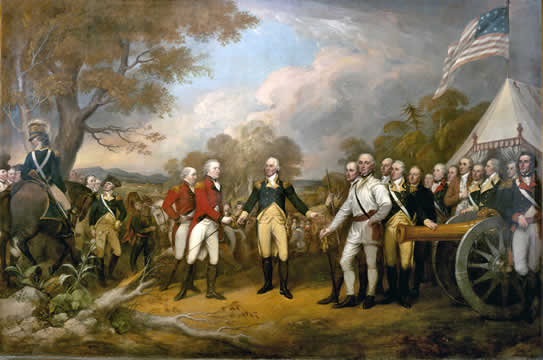
The Surrender of General Burgoyne (at Saratoga), by John Trumbull
First, study the two paintings shown above: The Surrender of Santa Anna at San Jacinto, marking the end of the Texas Revolution, and the Surrender of General Burgoyne at Saratoga, a key American victory considered the turning point of the American Revolutionary War.
Make some observations about the paintings—what are some similarities and what are some differences in the scenes?
Students may notice some of the following similarities and differences: Similarities: Differences:
When everyone is ready to continue, unlock the next part.
You have been studying the Texas Revolution in this course. The American Revolution happened earlier, and you may remember some information about it from previous grades or other experiences.
Before reading more about the American Revolution, think about what you already know. Submit one fact you remember about the American Revolutionary War. If someone has already posted the same fact, try to add a different one.

Students do not need to post a response in order to move on to the next scene. Use students’ responses to activate prior knowledge, but do not assume that students remember this content from earlier grades. Before moving on, review the key points below with the class. This information provides important background students will need to compare the American Revolution with the Texas Revolution later in the lesson. Review these points:
When everyone is ready to continue, unlock the next scene.