Add a Curriculum Bundle to Your Account!
Please select a bundle.





The Pack contains associated resources for the learning experience, typically in the form of articles and videos. There is a teacher Pack (with only teacher information) and a student Pack (which contains only student information). As a teacher, you can toggle between both to see everything.
Here are the teacher pack items for Political Participation in the Age of Jackson:


Overview In this experience, students explore how political participation expanded during the Age of Jackson and consider who benefited and who remained excluded. First, they use a chart to reflect on how voting rules and political participation shifted over time, making predictions about what this meant for democracy. Next, students analyze how parties, elections, and public life made politics more visible and participatory during Jackson’s presidency. Then, they weigh how well Jackson’s image as the “common man’s president” matched his actual choices by drawing on examples from across the unit. Finally, the Elaborate scene invites students to reflect on the role of women like Maria Stewart to show how political participation extended beyond voting and helped shape debates about equality and democracy. Estimated Duration: 45–60 minutes Vocabulary Words and Definitions Objectives:
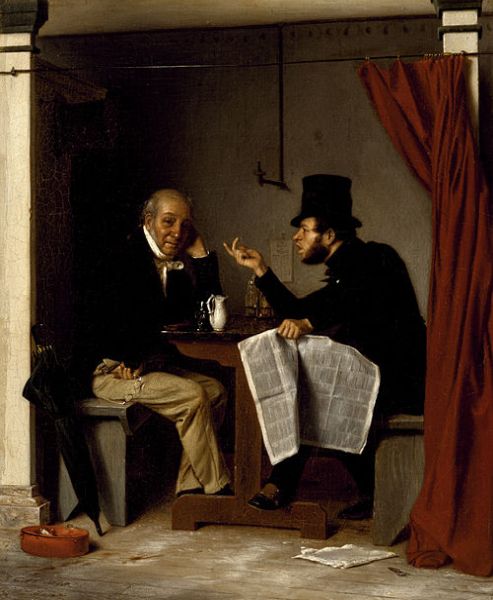
Politics in an Oyster House by Richard Caton (1848)
Andrew Jackson emerged as a national figure whose presidency became one of the most talked about in the country’s history. His time in office drew widespread attention and remains closely studied for what it reveals about the United States during that era.
Look at the table below. Use the chart to organize your ideas about political participation during the Age of Jackson.
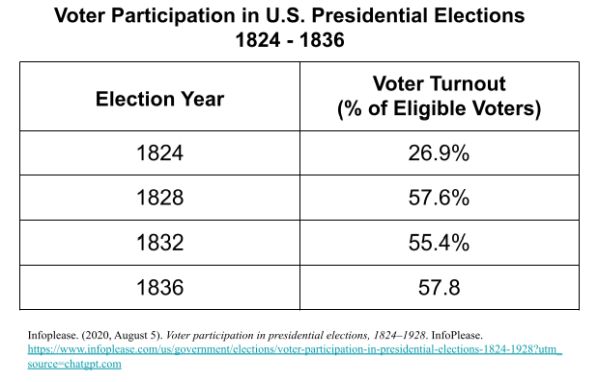
This activity helps students recall what they already know about voting before Jackson’s presidency and identify questions that will guide the rest of the experience. As students complete the Know/Need to Know chart, look for them to note that some white men gained voting rights leading into the 1828 election, while many groups remained excluded. Encourage them to record questions in the “Need to Know” column about why participation changed so quickly, how it was connected to Jackson and his presidency, why voter turnout declined in 1832, and why certain groups were excluded. Then ask: What might we learn about Jackson's presidency by studying changes in political participation during his time in office? Encourage students to think about how a president's actions, decisions, and leadership style might influence who chooses to participate in the political process and why.
In this experience, you will learn how political participation expanded during the Age of Jackson and consider whether Jackson truly lived up to his image as the “common man’s president.”
Objectives: