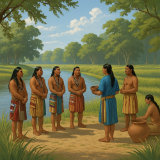
The Trail of Tears


The Trail of Tears
Students examine Indigenous resistance and the Treaty of New Echota. Then, they trace the Trail of Tears, where forced removal caused great hardship, but Native nations rebuilt communities, preserving culture and survival as a lasting legacy.

This learning experience is designed for device-enabled classrooms. The teacher guides the lesson, and students use embedded resources, social media skills, and critical thinking skills to actively participate. To get access to a free version of the complete lesson, sign up for an exploros account.

1:1 Devices
Teacher Pack

The Pack contains associated resources for the learning experience, typically in the form of articles and videos. There is a teacher Pack (with only teacher information) and a student Pack (which contains only student information). As a teacher, you can toggle between both to see everything.

Here are the teacher pack items for The Trail of Tears:

Preview - Scene 1
Exploros Learnign Experience Scene Navigation


Engage


Overview

In this experience, students investigate how resistance gave way to forced removal and how the Trail of Tears reshaped Native nations. First, they analyze a timeline to see how efforts to resist, including court cases and treaties, ultimately led to removal. Next, students examine the Treaty of New Echota to identify its causes and effects, including how it was used to justify removal. Then, students read about the Trail of Tears itself to understand the hardships, losses, and survival of Native nations as they traveled west and rebuilt in Indian Territory. Finally, the Elaborate scene invites students to explore how powwows today honor survival and cultural endurance as part of the Trail of Tears’ legacy.

Estimated Duration: 45–60 minutes

Vocabulary:

  • cede: the act of giving up land or territory to another country or group through a treaty or agreement
  • Trail of Tears: the forced journey of Native nations from their homelands to lands west of the Mississippi River where thousands died from hunger, disease and hardship
 

Objectives:

  • Explain how Indian Removal policies and the Treaty of New Echota led to the Trail of Tears
  • Examine the hardships faced on the Trail of Tears and how Native nations worked to survive


U.S. Policies relating to Indigenous people and the Indian Removal Act increased conflicts over land and power in the United States. After the law passed, debates and struggles unfolded about who had the authority to decide the future of Indigenous nations and how removal would be carried out. These events showed the tension between government policy and Indigenous rights.

Read the timeline below. Think about the BEST title for the timeline and then add your ideas to the class list
 
  • 1830: Congress passes the Indian Removal Act
  • 1832: President Jackson ignores the Supreme Court’s ruling on Cherokee sovereignty
  • 1835: Treaty of New Echota cedes Cherokee land
  • 1838: The U.S. Army forcibly removes the Cherokee from their land


Write a title for the timeline. Do not repeat answers.



After students share their titles, point out that the timeline shows both efforts to resist removal and events that led to it. Emphasize that resistance was real, but removal still moved forward. Let students know the following scenes will explore why this happened and what the impacts were. An exemplar title might say The Road to Cherokee Removal.


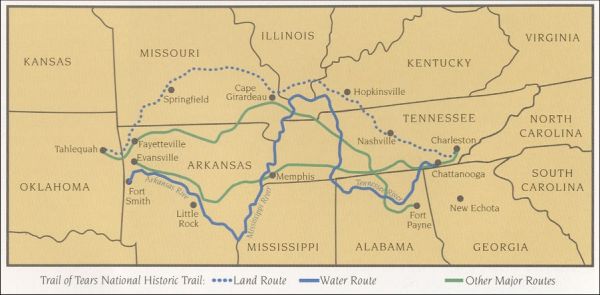
A historical map shows the routes of the Trail of Tears across the United States. The map displays three distinct paths: the dotted blue line for the land route, the solid blue line for the water route, and a green line for other major routes, all originating in the southeastern U.S. and ending in what is now Oklahoma.

Map showing the various routes on the Trail of Tears


In this experience, you will learn how government policies and treaties forced Indigenous nations from their homelands, leading to the Trail of Tears. You will also see how removal brought great hardship, but how Native nations resisted, endured, and worked to survive despite these challenges.

Objectives:

  • Explain how Indian Removal policies and the Treaty of New Echota led to the Trail of Tears
  • Examine the hardships faced on the Trail of Tears and how Native nations worked to survive


When everyone is ready to continue, unlock the next scene.

End of Preview
The Complete List of Learning Experiences in Age of Jackson Unit.
Would you like to preview the rest of this learning experience, and get access to the entire functioning US History Through 1877 course for your classroom? Sign up using your school email address below.
Back to top