Labor Reform


Labor Reform
Students learn how early workers responded to harsh industrial conditions by organizing, striking, and forming unions, and how changing court decisions shaped their ability to act together and push for fair wages, safer workplaces, and better treatment.

This learning experience is designed for device-enabled classrooms. The teacher guides the lesson, and students use embedded resources, social media skills, and critical thinking skills to actively participate. To get access to a free version of the complete lesson, sign up for an exploros account.

1:1 Devices
Teacher Pack

The Pack contains associated resources for the learning experience, typically in the form of articles and videos. There is a teacher Pack (with only teacher information) and a student Pack (which contains only student information). As a teacher, you can toggle between both to see everything.

Here are the teacher pack items for Labor Reform:

Preview - Scene 1
Exploros Learnign Experience Scene Navigation


Engage


Overview

Estimated Duration: 45–60 minutes

Vocabulary Words and Definitions

  • common law: a system of law based on court decisions and past examples rather than written rules
  • commonwealth: a political community founded for the common good, often referring to states or nations linked by shared goals
  • conspiracy: a secret plan by a group to do something harmful or unlawful
  • journeyman: a trained worker who has completed an apprenticeship and can work in a trade but is not yet a master
  • masters: skilled workers who have reached the highest level in their trade and can train others
  • mutual aid society: a group formed to support its members with help such as money, services, or protection
  • solidarity: unity and support among people with shared interests or goals
  • strike: when workers refuse to work in order to demand better conditions or pay
  • union: an organized group of workers who join together to protect their rights and improve working conditions

Objectives:

  • Describe how workers responded to harsh industrial working conditions in the early 1800s
  • Explain how important court decisions shaped the rights of workers to act collectively and influenced the growth of the labor movement


This experience introduces several terms that are central to understanding early labor reform, and students will rely on them across multiple scenes. Reviewing these definitions ahead of the Explore and Explain scenes can help students enter the content with confidence and focus more deeply on the historical patterns they are analyzing.


To go further, consider creating a class timeline by having students research key events in the early labor movement and produce short summaries with accompanying images to place along a shared chronological display. This visual sequence can help students discuss how different groups responded to workplace problems and contributed to emerging solutions across the period.


Early industrialization reshaped how goods were produced and how people worked, creating new kinds of jobs and expanding cities. These changes also affected the conditions under which people worked, leading to new experiences in the workplace.
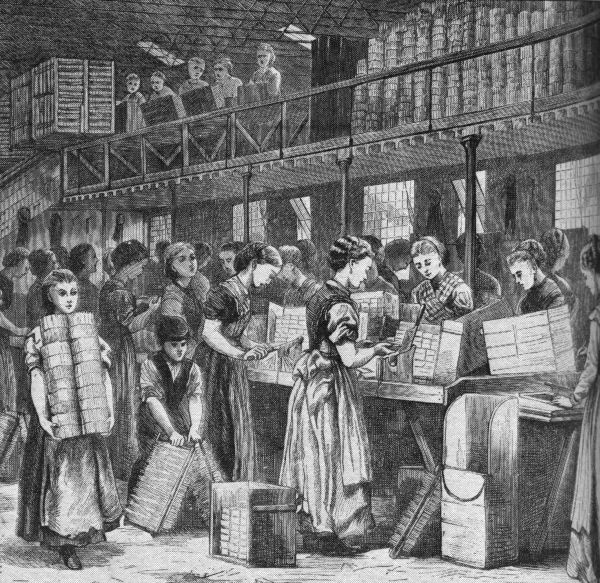

A black and white 19th-century engraving illustrates the interior of a crowded factory floor, likely a textile or book-binding operation, filled mostly with women and child workers. The workers are busy with various tasks, including carrying heavy stacks of material and operating machinery, with additional onlookers or supervisors standing on a balcony above.

Women working in a match factory


Look at the image and think about what it shows about working conditions in factories and mills during the mid-1800s. Add one word to the word wall that describes what those conditions were like.

Post your answer

When reviewing the word wall, help students connect the terms to what they learned about early industrialization by discussing how work and daily life shifted during this period. Ask students to share the details from the image that support their ideas. Then, guide students to recognize overall themes, such as harsh or unsafe conditions and major changes in how people earned a living by asking: What patterns do you notice across these words? and What do these terms suggest about what life was like for many workers? Help students recall how new machines and factory systems created fast-paced workplaces where owners focused on lowering costs.

Extend the conversation by asking: Why do you think working conditions often became difficult during industrialization, and how might this have affected the people doing the work?


In this experience, you will learn how workers responded to the challenges of life inside early factories and how key court decisions shaped their ability to organize, protest, and push for better treatment in the growing industrial economy.

  • Describe how workers responded to harsh industrial working conditions in the early 1800s
  • Explain how important court decisions shaped the rights of workers to act collectively and influenced the growth of the labor movement


When everyone is ready to continue, unlock the next scene.

End of Preview
The Complete List of Learning Experiences in Reform and Culture Unit.
Would you like to preview the rest of this learning experience, and get access to the entire functioning US History Through 1877 course for your classroom? Sign up using your school email address below.
Back to top