Add a Curriculum Bundle to Your Account!
Please select a bundle.





The Pack contains associated resources for the learning experience, typically in the form of articles and videos. There is a teacher Pack (with only teacher information) and a student Pack (which contains only student information). As a teacher, you can toggle between both to see everything.
Here are the teacher pack items for Reform and Culture: Review:


Overview In this experience, students review and reinforce key learning from the unit through reflection, vocabulary, and content practice. First, students activate their knowledge by reflecting on big ideas and takeaways from the unit. Then, students work with a partner to review key vocabulary terms using flashcards and apply their understanding through a collaborative task. Next, students repeat this structure with important content from the unit, using flashcards and an interactive activity to make connections across what they’ve learned. Finally, the Elaborate scene invites students to extend their learning through an optional writing activity that asks them to respond to big-picture questions, followed by a short exit ticket aligned to key standards. Estimated Duration: 45–60 minutes Vocabulary Words and Definitions: Objectives:
In this experience, students are asked to engage in group work and discussions. The experience is intentionally designed around questions that will elicit discussion, thinking, and application of learning as a review of the unit.
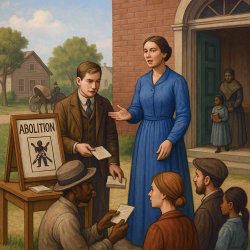
Throughout this unit, you’ve explored the major reform movements of the 1800s by looking at the problems people saw in society, why those problems demanded change, and the actions reformers took to try to solve them.
Objectives:
What do you think is the most important thing to understand about why so many Americans in the early 19th century committed themselves to solving the problems they saw in society?
After students complete their individual reflections, consider facilitating a whole-class or small-group share-out. Ask several students to explain what they chose as most important and why. Encourage classmates to respond to each other’s ideas by making connections, asking follow-up questions, or offering alternative perspectives. This discussion helps deepen thinking and allows students to see how others interpreted the question: What do you think is the most important thing to understand about why so many Americans in the early 19th century committed themselves to solving the problems they saw in society?