Add a Curriculum Bundle to Your Account!
Please select a bundle.


The Pack contains associated resources for the learning experience, typically in the form of articles and videos. There is a teacher Pack (with only teacher information) and a student Pack (which contains only student information). As a teacher, you can toggle between both to see everything.
Here are the teacher pack items for Europe: History and Its Influence: Europe after 1945:

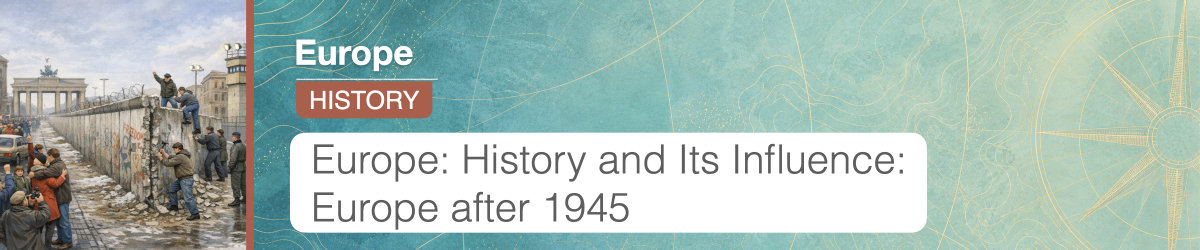
Overview In this experience, students examine Europe after 1945 by beginning with the fall of the Berlin Wall and using the event to investigate the broader Cold War division of the continent. They then explore how competing political systems and alliances shaped governments, borders, and daily life across Europe. Next, students examine the collapse of communist governments in Eastern Europe and consider how these changes reshaped Europe at the end of the Cold War. Finally, students develop interview questions designed to connect the larger political changes of the era to the experiences of people who lived through them. Objectives:
World War II ended in 1945, leaving much of Europe physically damaged, economically weakened, and politically divided. As countries rebuilt, tensions grew between two major powers: the United States and the Soviet Union.
These tensions developed into the Cold War, a long period of political, military, and economic competition that shaped Europe and many other parts of the world. Europe became divided between countries aligned mainly with the United States and countries dominated or strongly influenced by the Soviet Union.
In this experience, you will examine how the Cold War divided Europe, how that division affected people and governments, and how Europe changed as the Cold War eventually came to an end.
Objectives:
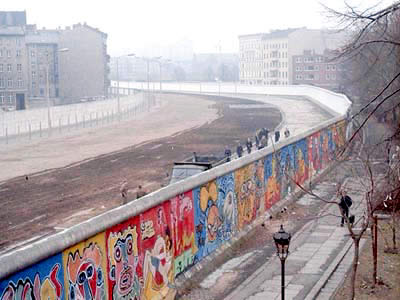
The Berlin Wall
Watch the news footage from Europe near the end of the Cold War. The video does not explain what is happening, so focus closely on the people, structures, tools, and reactions you observe.
Afterward, complete a See-Think-Wonder response based on the evidence in the footage.
Complete the table by explaining what you see, what you think and what you wonder based on the video.

Invite students to share observations, interpretations, and questions from their See-Think-Wonder charts. Keep the three categories separate at first: observations should describe visible evidence, while interpretations and questions may go beyond what can be directly seen. After students have discussed the footage, identify the event as the fall of the Berlin Wall in November 1989. Explain that the wall had divided East and West Berlin for decades and had become a powerful symbol of the larger Cold War division of Europe. Use students’ observations to begin building the historical context rather than simply explaining the event for them. Possible follow-up questions include: Explain that students will now investigate the Cold War developments that led to the division of Europe and eventually to scenes like the one they just observed. background_color:plain
When everyone is ready to continue, unlock the next scene.


