Add a Curriculum Bundle to Your Account!
Please select a bundle.


The Pack contains associated resources for the learning experience, typically in the form of articles and videos. There is a teacher Pack (with only teacher information) and a student Pack (which contains only student information). As a teacher, you can toggle between both to see everything.
Here are the teacher pack items for Western Europe: Government and Economy:

Overview In this experience, students examine the governments and economies of Western European countries, looking for both shared regional patterns and important differences. They first read an overview of the region’s economies and compare major industries, trade connections, resources, and services. Students then work in groups to research the government of one assigned country and present how it is organized, how leaders are chosen, and how citizens participate. Finally, students synthesize what they learned to explain how Western Europe can be a closely connected region while its countries maintain different governments and economic strengths. In scene 3, students will work in small groups. You will assign each group one of eight countries for research, so try to have at least eight groups. If you plan to teach the experience Western Europe: Society and Culture, you may want to assign students to the same small groups and the same country in order to give them a deeper familiarity with it. Objective:
Western Europe includes countries that are closely connected through trade, travel, history, and political cooperation. Many have democratic governments and market economies, but they do not all organize their governments or economies in the same way.
Some countries are constitutional monarchies, while others are republics. Some governments play a larger role in providing public services or regulating the economy than others. Countries also differ in their major industries, natural resources, trade relationships, and levels of government involvement in economic life.
In this experience, you will compare governments and economies across Western Europe and examine how political systems, economic choices, and regional cooperation shape life in different countries.
Objective:
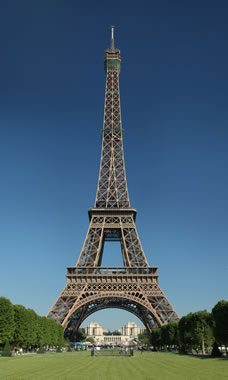
Answer the following questions if you can.

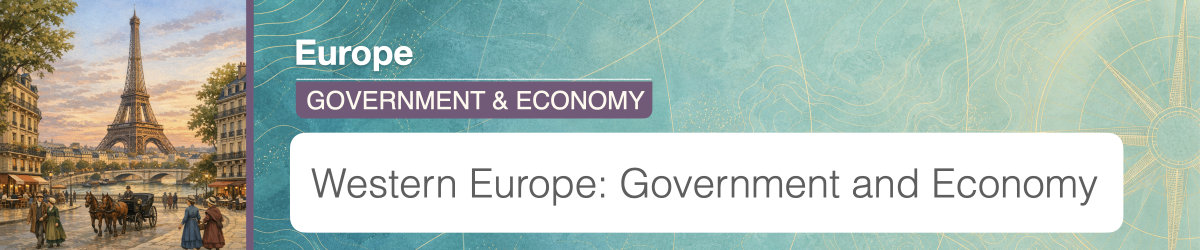
Invite students to share what they noticed, what economic connections they made, and what questions they have about the country. Identify the landmark as the Eiffel Tower in Paris, France. Use the discussion to help students connect a well-known cultural landmark to economic activity. Students may mention tourism, hotels, restaurants, transportation, shopping, jobs, or tax revenue. Then shift attention to the questions students generated about France. Sort or group their questions into broad categories such as government, economy, culture, geography, or daily life. Point out that this lesson will focus especially on how government and economic systems shape countries in Western Europe. Possible follow-up questions include:
When everyone is ready to continue, unlock the next scene.


