Add a Curriculum Bundle to Your Account!
Please select a bundle.


The Pack contains associated resources for the learning experience, typically in the form of articles and videos. There is a teacher Pack (with only teacher information) and a student Pack (which contains only student information). As a teacher, you can toggle between both to see everything.
Here are the teacher pack items for Europe: Natural Resources and the Environment:

Overview In this experience, students examine Europe’s major climates and natural resources and consider how they support agriculture, industry, energy production, and other human activities. They then investigate environmental challenges affecting different parts of Europe and work in small groups to research the causes, effects, locations, and responses to one specific issue. Finally, students explore one example of youth environmental involvement and consider how groups can respond to environmental challenges that may cross national borders. In scene 3, students will work together in small groups. Although this experience can stand alone, it works best with the Europe: Geographic Passport experience, which introduces students to the geography of Europe. Objectives:
Europe includes a wide range of climates, landscapes, and natural resources. Differences in latitude, elevation, landforms, and proximity to oceans and seas help create these geographic patterns.
Natural resources such as forests, fertile soil, minerals, water, and energy sources have influenced how people live and how economies develop across Europe. At the same time, human activities can affect the environment and the availability of these resources.
In this experience, you will examine Europe’s major climate regions and natural resources and explore environmental challenges connected to how people use the land and its resources.
Objectives:
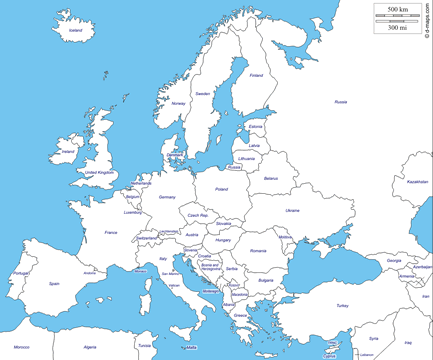
Europe is made up of about 50 countries, each with its own government, economy, resources, and environmental priorities. But air, rivers, seas, forests, wildlife, and climate do not stop at political borders.
Pollution produced in one country can travel into another. A river may flow through several countries before reaching the sea. Forests and wildlife habitats can stretch across national boundaries. This means that decisions made in one place can affect people and environments far beyond that country.
As you begin this lesson, think about the challenge of managing a shared environment when many different countries are involved.
What challenges might arise when many countries share natural resources and environmental systems?

Discuss student responses and encourage students to think beyond a single country. Students may identify challenges such as disagreements over how resources should be used, pollution moving across borders, different environmental laws, or the difficulty of protecting shared rivers, seas, forests, and wildlife. Emphasize that countries may have different needs and priorities even when they share the same environmental systems. Use the discussion to introduce the idea that managing Europe’s resources often requires cooperation across national borders.
When everyone is ready to continue, unlock the next scene.


