Add a Curriculum Bundle to Your Account!
Please select a bundle.



The Pack contains associated resources for the learning experience, typically in the form of articles and videos. There is a teacher Pack (with only teacher information) and a student Pack (which contains only student information). As a teacher, you can toggle between both to see everything.
Here are the teacher pack items for Southern Europe: Government and Economy:

Overview In this experience, students examine how the geography of Southern Europe, including its major peninsulas, coastlines, climate, and location along the Mediterranean, influences economic activity. They compare the economies of Italy, Spain, Portugal, and Greece, focusing on industries, agriculture, tourism, trade, and transportation. Students then research the government of one Southern European country and create a news story explaining how it is organized and how citizens participate. Finally, they return to their original economic predictions and use evidence from multiple countries to explain how geography helps shape the region’s economy. Objectives:
Southern Europe includes countries located along the Mediterranean Sea, many of them on or near major peninsulas. The region’s coastlines, mountains, climate, and location between Europe, Africa, and Asia have influenced trade, agriculture, transportation, tourism, and settlement for centuries.
The countries of Southern Europe are connected through regional trade and cooperation, but they also differ in their industries, resources, governments, and economic strengths.
In this experience, you will examine how geography helps shape the economies of Southern European countries and compare how their governments and economic systems are organized.
Objectives:
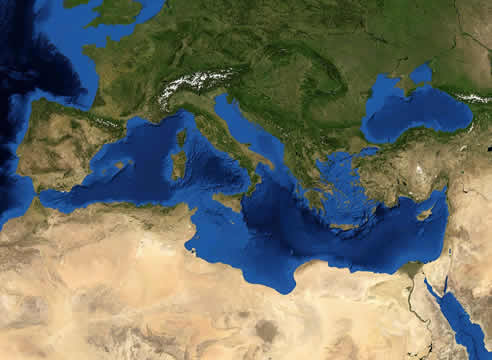
Satellite Image of Southern Europe
Based on the geography of Southern Europe, what economic activities do you predict are important in the region?
Invite students to share their predictions and ask them to point to specific geographic features on the map that support their ideas. Guide students to consider how coastlines, access to the Mediterranean Sea, mountains, climate, and location along major trade routes might influence economic activity. Students may predict activities such as shipping, fishing, tourism, agriculture, or trade. Emphasize that these are predictions based on geographic evidence. Students will test and refine their ideas as they learn more about the economies of Southern Europe. Possible follow-up questions include:
When everyone is ready to continue, unlock the next scene.


