Add a Curriculum Bundle to Your Account!
Please select a bundle.


The Pack contains associated resources for the learning experience, typically in the form of articles and videos. There is a teacher Pack (with only teacher information) and a student Pack (which contains only student information). As a teacher, you can toggle between both to see everything.
Here are the teacher pack items for Arabia and Iraq: Society and Culture:

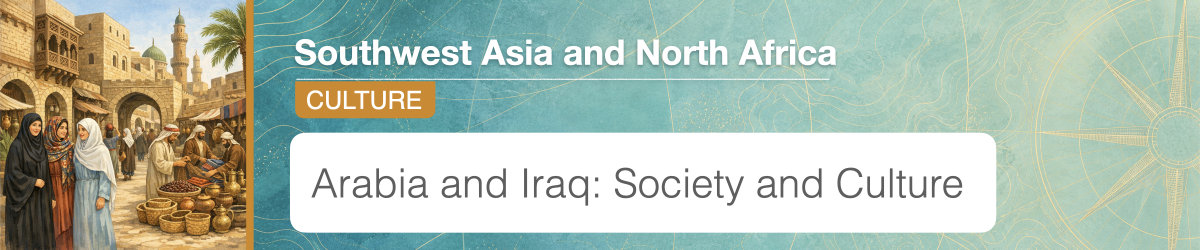
Overview In this experience, students examine the role of religion in the societies and cultures of Iraq and the Arabian Peninsula, including both Islamic traditions and other religious communities. They then investigate the culture of one country in greater depth, exploring language, religion, traditions, everyday life, and cultural change. Finally, students compare shared regional influences with differences among countries and communities. Objectives:
Iraq and the Arabian Peninsula are home to societies shaped by thousands of years of migration, trade, religion, family traditions, and cultural exchange. People across the region share some cultural influences, including the widespread use of Arabic and the importance of Islam, but traditions and ways of life vary among countries and communities.
Culture can be expressed through religion, language, family life, clothing, food, music, art, celebrations, and other traditions. These practices are not fixed. Education, migration, technology, economic change, and contact with other societies can all influence how cultures change over time.
In this experience, you will examine religious and cultural traditions across Iraq and the Arabian Peninsula, compare similarities and differences, and explore how social roles and opportunities, including those of women, are changing in different parts of the region.
Objectives:
Take a look at the following photos:
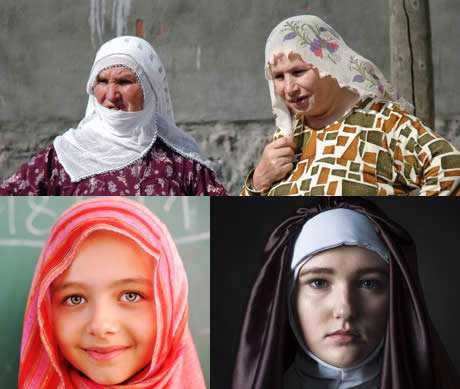
What can these images tell you about culture, and what can’t they tell you?
After students respond, invite several students to share what they think the images can tell them and what they cannot know from appearance alone. Use the discussion to introduce the idea that visible cultural markers can provide clues, but they do not fully explain a person’s identity, beliefs, experiences, or choices. Clothing can be influenced by religion, family traditions, local customs, personal preference, climate, or other factors, and the same type of clothing can have different meanings for different people. Possible follow-up questions include:
Invite students to write questions they have as a response in their wall post.
Scene 2 addresses some of the non-Islamic religions in the region. For more information about the beliefs and practices of IsWhen everyone is ready to continue, unlock the next scene. lam, see the experience “Religion and Its Influence: The Origins of Islam.”
When everyone is ready to continue, unlock the next scene.


