Add a Curriculum Bundle to Your Account!
Please select a bundle.



The Pack contains associated resources for the learning experience, typically in the form of articles and videos. There is a teacher Pack (with only teacher information) and a student Pack (which contains only student information). As a teacher, you can toggle between both to see everything.
Here are the teacher pack items for North Africa: History and Its Influence:

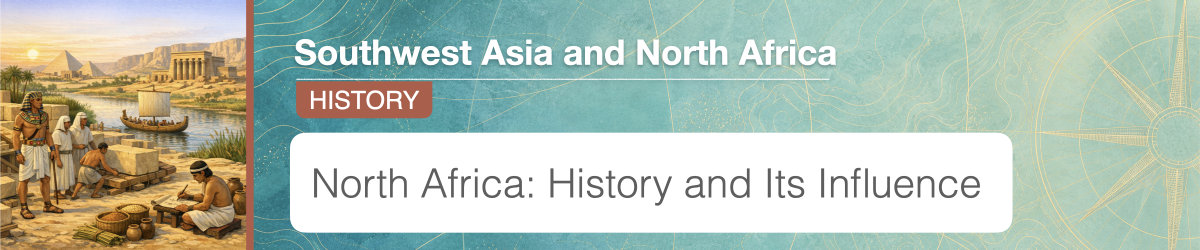
Overview In this experience, students examine major developments in North African history, beginning with ancient Egypt and the ways its society expressed beliefs through religion, government, and cultural practices. They then trace later historical changes across North Africa, including empire, colonization, independence, and political developments after independence. Finally, students analyze how events from different periods continue to influence North African societies today. In scene 3, students will work in small groups. There should be at least six groups to cover the six countries of Northern Africa. Objectives:
North Africa has been home to many different societies, kingdoms, empires, religions, and cultural traditions over thousands of years. Its location along the Mediterranean Sea, beside the Sahara, and near Southwest Asia helped connect the region to trade routes, migrations, invasions, and the spread of new ideas.
The countries of North Africa share some historical experiences, but they did not all develop in the same way. Indigenous Amazigh communities, ancient Egyptian civilization, Phoenician and Roman influence, the spread of Christianity and Islam, Arab migration, Ottoman rule, European colonization, and independence movements all shaped different parts of the region at different times.
These historical changes affected language, religion, government, culture, and relationships among the countries of North Africa.
In this experience, you will trace major turning points in the history of North Africa and examine how past events continue to influence the region today.
Objectives:
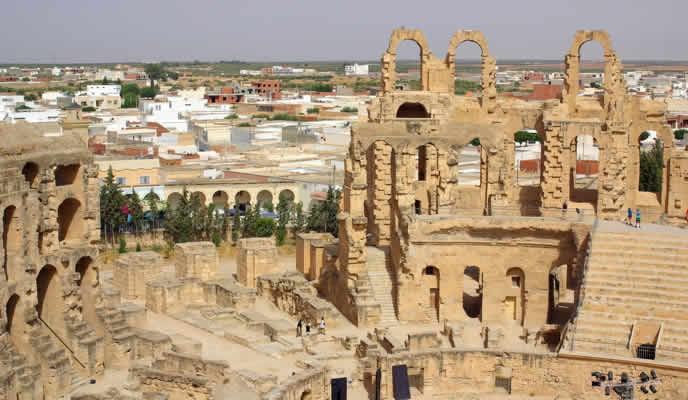
What does this image suggest about the ways history can remain part of a place long after a civilization has changed?
Invite students to share the clues they noticed in the image and explain what those clues suggest about the relationship between past and present. Encourage them to move beyond simply identifying old and new buildings and instead think about what it means for evidence of earlier societies to remain part of a modern place. Use the discussion to introduce the idea that history can influence a region long after a particular empire, government, or civilization has changed. Possible follow-up questions include:
When everyone is ready to continue, unlock the next scene.


