Add a Curriculum Bundle to Your Account!
Please select a bundle.




The Pack contains associated resources for the learning experience, typically in the form of articles and videos. There is a teacher Pack (with only teacher information) and a student Pack (which contains only student information). As a teacher, you can toggle between both to see everything.
Here are the teacher pack items for North Africa: Government and Economy:

Overview In this experience, students examine how government and economic conditions contributed to the Arab Spring in North Africa, focusing on Tunisia, Egypt, and Libya and the different paths each country followed after the uprisings. They then explore major features of North African economies, including natural resources, trade, agriculture, manufacturing, services, and economic interdependence. Finally, students consider how social media influenced communication and organization during the Arab Spring. Objectives:
The governments and economies of North Africa have changed significantly over time. Countries in the region have been shaped by long periods of empire, colonial rule, independence movements, economic development, and changing relationships between citizens and political leaders.
After gaining independence during the 1900s, North African countries developed different forms of government and faced different economic challenges. In some places, political power became concentrated in the hands of long-serving leaders. At the same time, many people experienced concerns about unemployment, rising costs, corruption, and limited opportunities to influence government decisions.
Beginning in late 2010, these pressures helped spark a wave of protests across North Africa and the Middle East. The movements became known as the Arab Spring. The protests did not unfold the same way in every country. In some places, leaders were removed from power. In others, political change was more limited or was followed by conflict and instability.
In this experience, you will examine Tunisia, Egypt, and Libya to explore how government, economic conditions, and citizen action became connected during the Arab Spring and how each country changed afterward.
Objectives:
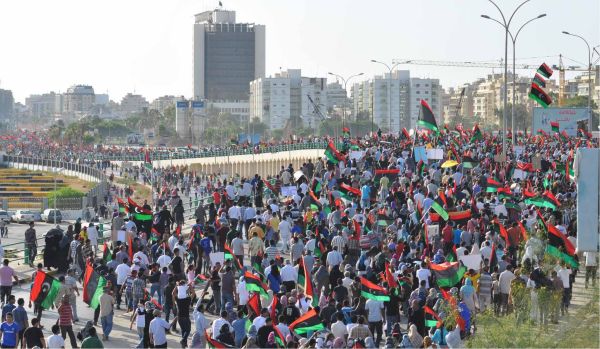
In one word, what might people be seeking when they join a protest like this? To list multiple words, separate them with a coma like this: cat, dog.
As the word cloud develops, ask students to look for the words that appear most often and consider why those ideas may be associated with protest. Draw attention to repeated concepts such as change, freedom, rights, justice, reform, opportunity, or representation. Use the cloud as a starting point for the experience rather than as a list of correct answers. Explain that people join protests for different reasons, and those reasons can include political, economic, and social concerns. Possible follow-up questions include:
When everyone is ready to continue, unlock the next scene.


