Add a Curriculum Bundle to Your Account!
Please select a bundle.




The Pack contains associated resources for the learning experience, typically in the form of articles and videos. There is a teacher Pack (with only teacher information) and a student Pack (which contains only student information). As a teacher, you can toggle between both to see everything.
Here are the teacher pack items for Declaration of Independence:


Overview In this experience, students analyze the Declaration of Independence as both a political argument and a statement of nationhood by examining the rights it claims, the grievances it lists, and the powers it declares. First, they reflect on what rights they believe cannot be taken away from anyone. Then, they analyze the Declaration and explore the concept of unalienable rights. Next, students examine the document’s grievances against the king and consider how those complaints justified the break from British rule. Afterward, they analyze the conclusion of the Declaration to identify the powers the colonies claimed as free and independent states. Finally, the Elaborate scene invites students to evaluate how the Declaration's message about equality was limited by who was excluded and consider how those exclusions shaped the nation’s founding ideals. Estimated Duration: 55–70 minutes Vocabulary Words and Definitions Objectives:
This experience includes six scenes to ensure students have the time and structure needed to engage deeply with the Declaration of Independence. Each scene focuses on a different section or idea from the document, allowing students to break down complex language, examine the meaning of key phrases, and reflect on the significance of the colonists’ arguments. Spreading the analysis across multiple scenes supports comprehension and encourages closer, more thoughtful reading. As a result, it is likely that this experience will take longer than one class period.
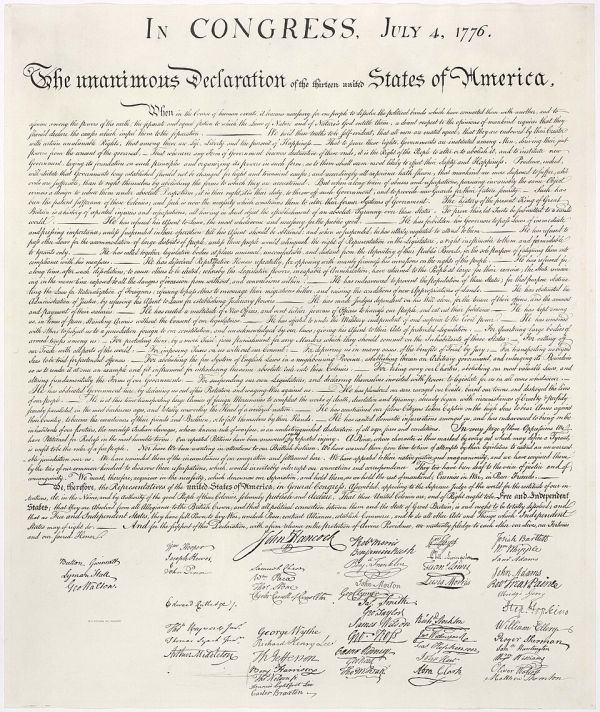
The Declaration of Independence (July 4, 1776)
The Second Continental Congress approved the Declaration of Independence in 1776. The Declaration announced the colonies' decision to break from British rule. Beyond declaring independence, it also expressed ideas about individual rights and the role of government.
Part of the Declaration lists rights that cannot be taken away by anyone. Think about which rights you think people should have that cannot be taken away. Use the drawing tool to share your ideas.Choose or draw an image and write a caption explaining which rights you think cannot be taken away from anyone and why you think those rights are important.

This drawing and caption activity gives students an entry point into the concept of unalienable rights using personal reflection as a foundation for later analysis. Since the term unalienable appears directly in the Declaration of Independence, this is a strategic time to review its meaning. Clarify that unalienable rights are those that cannot be taken away or surrendered. Emphasize that the Declaration lists specific examples. Students do not need to use the term in their responses, but they should begin thinking about what kinds of rights are considered fundamental and why. Ask: What are some rights that you think should never be taken away? Use this moment to surface prior knowledge, generate ideas about fundamental rights, and prepare students for the vocabulary and concepts they will encounter in the primary source in the next scene.
In this experience, you will learn how the Declaration of Independence used specific complaints and bold claims to explain the colonies’ break from British rule. You will also examine what the document reveals about the political ideas and values that helped shape a new nation.
Objectives: