Patriots vs. Loyalists – The Debate Over Independence


Patriots vs. Loyalists – The Debate Over Independence
Students explore the contributions of significant individuals in the American Revolution by conducting independent research. They craft and support claims about these contributions, considering how research shapes their understanding of historical events.

This learning experience is designed for device-enabled classrooms. The teacher guides the lesson, and students use embedded resources, social media skills, and critical thinking skills to actively participate. To get access to a free version of the complete lesson, sign up for an exploros account.

1:1 Devices
Teacher Pack

The Pack contains associated resources for the learning experience, typically in the form of articles and videos. There is a teacher Pack (with only teacher information) and a student Pack (which contains only student information). As a teacher, you can toggle between both to see everything.

Here are the teacher pack items for Patriots vs. Loyalists – The Debate Over Independence:

Preview - Scene 1
Exploros Learnign Experience Scene Navigation

Engage


Overview

In this experience, students explore the differences between Patriot and Loyalist perspectives on the American Revolution by evaluating primary and secondary sources and developing claims supported by evidence. They begin with an overview of the reasons colonists chose to give allegiance to the Patriots, the Loyalists, or remain neutral. Next, students analyze curated primary and secondary sources that present different perspectives on allegiance from both sides. Then, they write two claims to show which side had the stronger reasons for their allegiance and support their claims with evidence. Finally, students share their ideas in small-group discussions, considering how studying multiple perspectives deepens their understanding of the causes of the war. The Evaluate scene also provides students with the opportunity to reflect on their research, writing, and discussion skills.

Estimated Duration: 45–60 minutes

Vocabulary Words and Definitions:

  • allegiance: loyalty or commitment to a group or cause
  • neutralists: colonists who did not take sides during the American Revolution
  • tories: colonists who remained loyal to the British king during the American Revolution


Objectives:

  • Explain the factors that influenced where colonists gave their allegiances during the Revolution
  • Develop and support claims to compare Loyalist and Patriot perspectives on allegiance during the Revolution
  • Discuss how evaluating multiple perspectives shapes understanding of the causes of the Revolution


Although this experience does not include any elements that require group work, students will participate in a discussion in Scene 4 where they share and compare their claims with partners or small groups. This conversation is designed to give students the opportunity to explain their reasoning, listen to different perspectives, and reflect on the strength of evidence used in their claims. To facilitate the discussion, consider previewing the activity and creating groups beforehand.
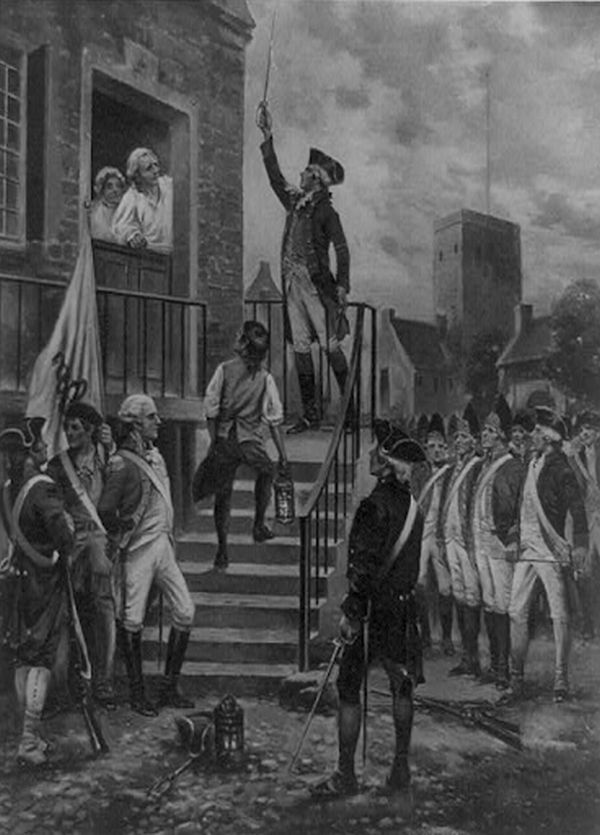

As you have learned, colonists during the American Revolution did not all agree on what was best for the future. Some supported independence from Britain and were called Patriots. Others stayed loyal to the British king and were known as Loyalists. These opposing sides had different reasons for their beliefs.

In this lesson, you will compare their perspectives to evaluate what influenced their decisions and why those choices mattered.

Objectives:

  • Explain the factors that influenced where colonists gave their allegiances during the Revolution
  • Develop and support claims to compare Loyalist and Patriot perspectives on allegiance during the Revolution
  • Discuss how evaluating multiple perspectives shapes understanding of the causes of the Revolution


A black-and-white engraving shows a man in a military uniform and a tricorn hat standing on the front steps of a building, holding a sword over his head. Below him, a crowd of soldiers stands at attention, and two people watch from a window as a man with a lantern walks down the stairs.

Patriot Soldier, Ethan Allen, demanding the surrender of Fort Ticonderoga


Which factor do you think most influenced which side colonists supported during the American Revolution?

A) government and economy
B) safety and protection
C) family and community
D) new ideas read or heard

After the poll, ask students to use reasoning to explain why they chose their response and what influenced their thinking. For added engagement, consider starting with a Four Corners activity where students move to a corner of the room based on their opinion, then explain their reasoning before returning to the platform to complete the poll.

Support students in the discussion by reminding them to think about the motivations behind each side’s beliefs. They may remember this idea from the last unit. Spiral learning by asking questions like: What did people hope to gain? What were they trying to avoid? What factors influenced their decision to support one side over the other?


When everyone is ready to continue, unlock the next scene.

End of Preview
The Complete List of Learning Experiences in American Revolution Unit.
Would you like to preview the rest of this learning experience, and get access to the entire functioning US History Through 1877 course for your classroom? Sign up using your school email address below.
Back to top