Overview
In this experience, students review and reinforce key learning from the unit through reflection, vocabulary, and content practice. First, students activate their knowledge by reflecting on big ideas and takeaways from the unit. Then, students work with a partner to review key vocabulary terms using flashcards and apply their understanding through a collaborative task. Next, students repeat this structure with important content from the unit, using flashcards and an interactive activity to make connections across what they’ve learned. Finally, the Elaborate scene invites students to extend their learning through an optional writing activity that asks them to respond to big-picture questions, followed by a short exit ticket aligned to key standards.
Estimated Duration: 45–60 minutes
Vocabulary Words and Definitions:
- activism: actions like protests, boycotts, petitions, or other actions used to bring about political or social change
- boycott: to refuse to buy or use certain goods or services as a form of activism
- committee: a group of people chosen to work together on a specific task or goal
- consent: permission or agreement for something to happen or be done
- convene: to come together for a meeting or activity
- decisive: settling an outcome or conflict in a conclusive way that makes a result certain
- declaration: a formal public statement
- delegate: a person chosen to represent others at a meeting
- First Continental Congress: a meeting of colonial leaders in 1774 in Philadelphia that convened in response to the Intolerable Acts
- formal: something that is official and follows set rules or traditions
- grievances: complaints or concerns about unfair treatment or wrongs
- impose: to force something, like a law or rule, to be accepted
- independence: freedom from being ruled by another person or country
- land grant: free land given by a government to encourage settlement or reward service
- liberty: the state of being free and able to make choices
- Loyalists: colonists who remained loyal to Britain during the American Revolution
- morale: the overall confidence, spirit, or enthusiasm of a group
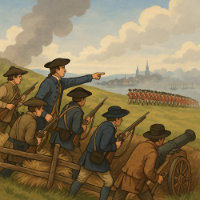
- militia: a group of local, part-time soldiers who are not part of a regular army
- oppose: to be against something or to try to stop it
- Parliament: the group in Britain that makes laws and decisions for the country
- pamphlet: a short printed booklet used to share ideas or information
- Patriots: colonists who supported independence from Britain
- petition: a formal written request asking for a change, signed by many people
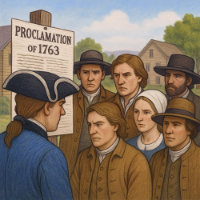
- proclamation: an official public announcement made by a person in power
- protest: a public gathering where people show strong disagreement with a rule or decision, often using images, signs, or speech to express their views
- punitive: meant to punish or cause suffering
- rebel: a person who resists or fights against authority
- Red Coats: nickname for British soldiers based on the red jackets of their uniforms
- reinforcements: extra soldiers sent to support a battle
- repeal: to officially cancel a law so it no longer exists
- resistance: efforts to fight against or refuse to accept something, like unfair rules or control
- resolve: a firm decision or agreement to do something
- retreat: when soldiers move back to avoid fighting or danger
- siege: when an army surrounds a place to cut it off with the aim of forcing a surrender from the opposition
- Sons of Liberty: a group of colonial men who organized protests against British rule
- speculator: someone who buys land or goods hoping to sell them later for a profit
- state: a political group with its own government and territory
- supplies: materials and resources needed to complete a task
- suppress: to stop something by using force or control
- tax: money people must pay to the government to support its work
- terms: the conditions or agreements that are officially decided in a treaty or contract
- Treaty of Paris of 1783: the agreement that officially ended the American Revolution and recognized the United States as an independent nation
- tyrant: a ruler who uses power in a harsh or unfair way
- tyranny: unfair and cruel use of power by a ruler or government
Objectives:
- Reflect on and apply key vocabulary and content knowledge from the unit
- Demonstrate understanding of major unit concepts through collaborative and written review activities
In this experience, students are asked to engage in group work and discussions. The experience is intentionally designed around questions that will elicit discussion, thinking, and application of learning as a review of the unit.
Throughout this unit, you’ve explored how a struggle for independence grew from conflict into revolution, and how new ideas about freedom and government began to take shape. You examined why the Revolution started, what it changed, and how people viewed it in different ways.
Objectives:
- Reflect on and apply key vocabulary and content knowledge from the unit
- Demonstrate understanding of major unit concepts through collaborative and written review activities
After students complete their individual reflections, consider facilitating a whole-class or small-group share-out. Ask several students to explain what they chose as most important and why. Encourage classmates to respond to each other’s ideas by making connections, asking follow-up questions, or offering alternative perspectives. This discussion helps deepen thinking and allows students to see how others interpreted the reasons the American colonies felt they had no other choice but to break away from Great Britain.