Add a Curriculum Bundle to Your Account!
Please select a bundle.



The Pack contains associated resources for the learning experience, typically in the form of articles and videos. There is a teacher Pack (with only teacher information) and a student Pack (which contains only student information). As a teacher, you can toggle between both to see everything.
Here are the teacher pack items for The Boston Massacre:

Overview In this experience, students evaluate who was responsible for the Boston Massacre by analyzing sources with different perspectives. This experience is intended to be engaged in after students have learned about the basic timeline of events leading to the American Revolution, including the Boston Massacre. The goal of this experience is to examine deeper, analyze primary sources, and examine bias and perspective. If students have not already examined the events leading up to the American Revolution, including the Boston Massacre, consider engaging in the Experience, "Rising Tensions in the Colonies" first. In this experience students first examine artistic depictions of the event and discuss whether the details give the same account of the event. Next, students explore Paul Revere’s engraving to evaluate which details are accurate and which are exaggerated. Then, students analyze firsthand accounts from both colonists and British witnesses to compare how each side described the event. In the Elaborate scene, students are invited to examine John Adams' defense of the soldiers and evaluate how his argument connected to the colonists’ ideas about justice and fairness. Finally, in the Evaluate scene, students develop a claim about who was responsible for the Boston Massacre and support their claims with evidence they evaluated during the experience. Note that this experience does not have a traditional evaluate quiz in Scene 5. Instead this experience is designed to give students an opportunity to express their understanding through writing. Estimated Duration: 55-70 minutes Vocabulary Words and Definitions: Objectives:
As you have learned, the Boston Massacre was a fight between British soldiers and colonists in Boston in 1770. But there’s more to the story than just a street conflict. Why did it happen? Who was involved? Who was responsible? And how did this one event become such an important part of the growing tension between the colonies and Great Britain?
Evaluate the two paintings below that depict the Boston Massacre. Think about what they reveal about the Boston Massacre. Then, answer the discussion question.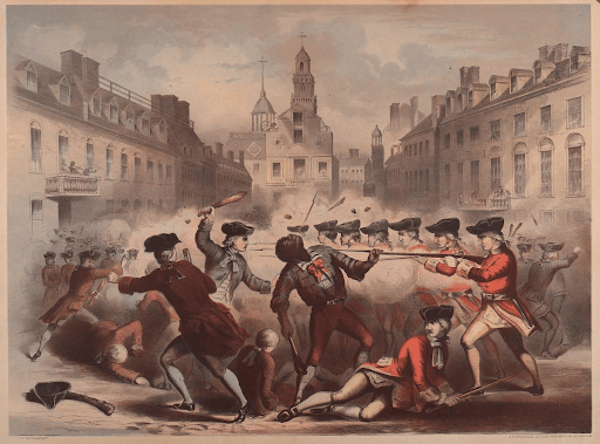
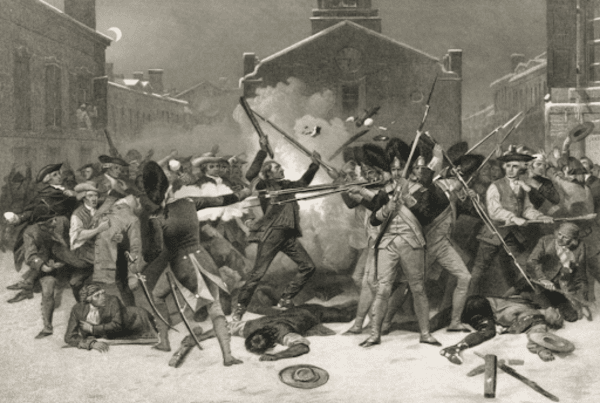
“The Boston Massacre” by Alonzo Chappel (1878)
Do these artistic depictions of the Boston Massacre tell the same story? What details from the images support your answer?
When reviewing the discussion, highlight how students used visual evidence to support their thinking. Prompt them to notice how the two images emphasize different actions, emotions, or outcomes. Use the following questions to guide discussion:
In this experience, you will investigate how conflicting accounts of the Boston Massacre reveal differing perspectives in order to evaluate who was responsible.
Objectives: