Add a Curriculum Bundle to Your Account!
Please select a bundle.


The Pack contains associated resources for the learning experience, typically in the form of articles and videos. There is a teacher Pack (with only teacher information) and a student Pack (which contains only student information). As a teacher, you can toggle between both to see everything.
Here are the teacher pack items for The Boston Tea Party:

Overview In this experience, students evaluate the impact of the Boston Tea Party by analyzing causes, reactions, and perspectives. First, students will reflect on what they already know about the Boston Tea Party and develop questions they have about the event. Next, students will explore the causes of the Boston Tea Party more deeply by examining the Tea Act and the colonists’ response to it, leading to the event. Then, they evaluate two short primary accounts in the days after the event and discuss whether or not the Tea Party hurt or helped the colonists’ cause. Finally, the Elaborate scene invites students to analyze a primary source image to consider how people have wanted the Tea Party to be remembered. Estimated Duration: 45–60 minutes Vocabulary Words and Definitions: Objectives:
Students briefly covered the Boston Tea Party in the “Rising Tensions in the Colonies” experience and in the Elaborate scene in the “Boycotts, Protests, and Colonial Activism” experience. Use this as an opportunity to activate prior knowledge and build on the idea that conflict between the colonies and Britain progressed over time, not all at once. This moment of spiraling helps students place the event in a larger cycle of actions and reactions. It also gives students a chance to examine different perspectives on the protest while learning more specific details about its causes and effects.
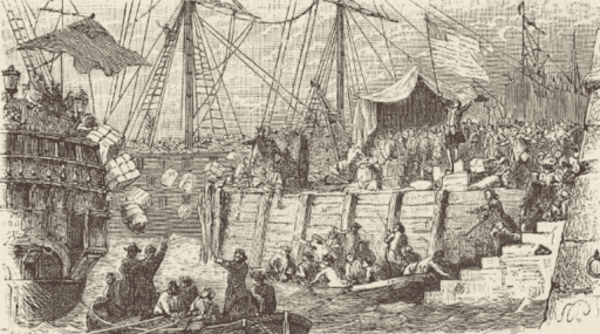
The Boston Tea Party by Paul Pilippoteaux and Henri T. Hildibrand (1881)
As you have learned, Boston was a central place for colonial resistance. People there organized protests, spread revolutionary ideas, and challenged British rule in bold ways. About three and a half years after the Boston Massacre, another event took place in Boston that pushed the colonies and Britain even closer to war. This event was the Boston Tea Party.
Brainstorm what you already know about the Boston Tea Party and think about what you want to know. Record your ideas in the chart below.After students complete the Know–Want to Know chart, choose a few responses to highlight patterns or surprising ideas. Look for early connections to causes or consequences of the Boston Tea Party, and take time to surface any misconceptions. Ask: Which ideas in our "Know" column describe causes of the Boston Tea Party, and which describe its consequences? Encourage students to use specific ideas from their charts to support their responses and build on one another's thinking.
Consider returning to this chart at the end of the experience and turning it into a full KWL chart. Before the Evaluate scene, use it as a review tool by asking students to recall what they have learned and discuss how their questions were answered. Record responses on the board or projector to help reinforce key content and support students in making final connections.
In this experience, you will investigate what led to the Boston Tea Party and how people at the time responded to it. You will think about how perspectives influenced those responses and how they continue to shape the way we understand the event today.
Objectives: